

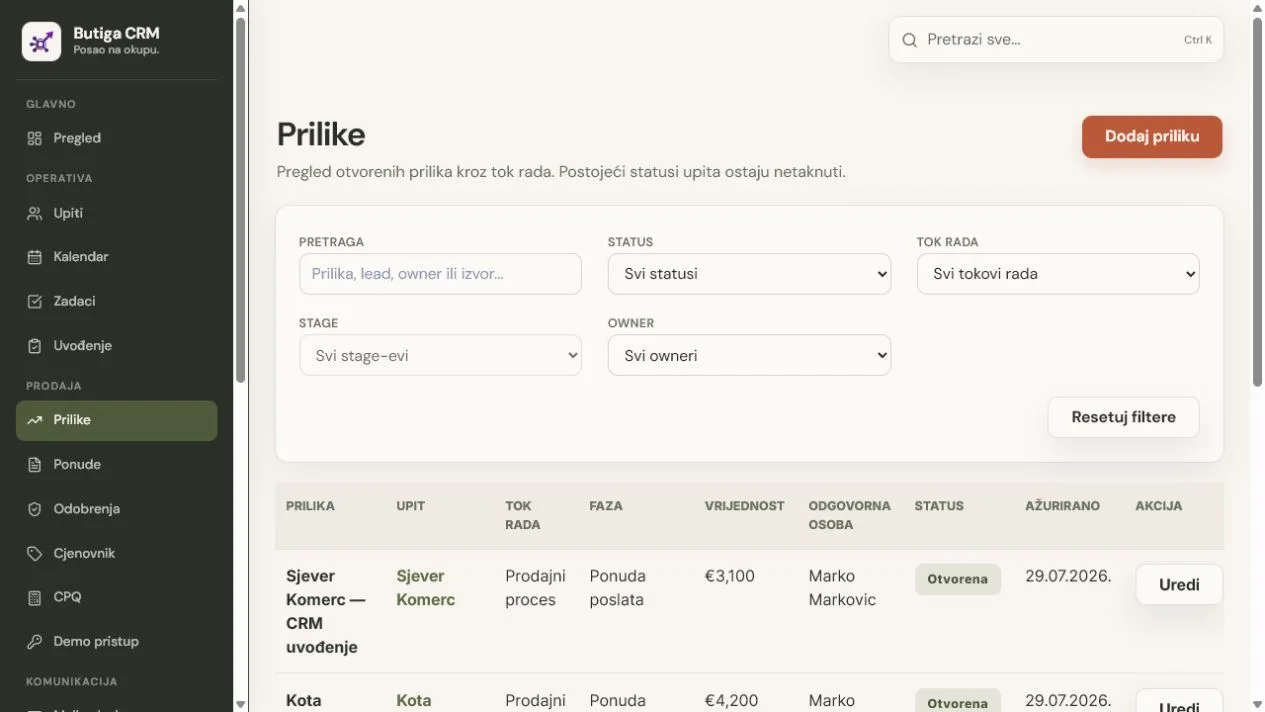
A CRM for sales teams should establish clear responsibility without constant checks through messages and meetings. In Butiga, a lead and sales opportunity can have an owner, stage, value, decision deadline and next step. Email, activities, tasks, meetings and quotes stay with the customer. Salespeople know what belongs to them, and authorised managers see a shared pipeline and items needing a response.
Where team sales processes usually break down
- Lead doesn't have a clear owner.
More people see the question, but no one knows who's responsible for taking the next step. - Follow-up is not verifiable.
The deal stays in a private calendar or inbox, without a deadline the team can see. - Pipeline depends on the oral report.
The manager only finds out at the meeting that the opportunity has stalled or that the assessment is no longer realistic. - Phase change has no context.
The opportunity moves, but it's not clear who did it, when and why. - The offer lives outside of CRM.
The team does not immediately see the version that was sent, the price and whether it is waiting for approval. - A won deal stays with sales.
Operations does not receive the accepted quote, promised scope and onboarding owner in time.
One sales flow, different responsibilities
Butiga uses administrator, sales manager, sales agent and onboarding support roles. Access is tied to the active workspace. A sales agent can be restricted to assigned leads and tasks or tasks belonging to their leads. Sales managers and administrators have a broader team overview, while onboarding support works with won deals and handoff commitments.
This division does not replace the agreement on the team. It helps to implement the agreed responsibility in daily work: the owner stays with the record, the task has a person and deadline, and the more sensitive administrative functions are not available to any role.
Illustrative example: from lead assignment to work handoff
- A new enquiry enters Butiga. The manager or authorised member of the team shall check the data and determine the owner.
- The salesperson qualifies the lead. Record the problem, contact, value, probability, expected date of decision and next step.
- The opportunity moves through the pipeline. The change of phase remains in history with time and with the person who made it; a reason is added if necessary.
- Communications and tasks remain with the client. Email, meeting and follow-up do not need to be reconstructed from private tools.
- The manager looks at the exceptions. They filter deals by owner, stage or status and respond to overdue contacts, open tasks or opportunities without a next action.
- The quote and outcome complete the sales stage. A won deal with an accepted quote and promised scope is handed to the onboarding owner.
Note: This example describes a real Butiga workflow. Customer names, amounts, users and dates on the screen are for demonstration.
The manager sees how the decision can actually progress
The stage and value are not sufficient if the team does not know who makes the decision with the customer. The relationship map, with the opportunity, separates the decision-maker, internal advocate, influential participants and blockers, along with the strength of the relationship and attitude. Thus, the review of pipeline gets the human context without turning the seller's notes into an automatic assessment.
When a buyer opens the controlled quote room, the team receives a view signal. When they reply by email, the assistant can suggest a lead link and next step, but the user confirms its application. The manager sees evidence of activity while business decisions remain with the responsible person.
What salespeople see during their working day
- the leads and opportunities they own;
- the contact and the company related to the sales context;
- business e-mail, activities and meetings with the client;
- the tasks assigned and the following deadlines;
- the phase, value and expected date of the decision;
- offers and the next step needed to make the job progress;
- mobile access to supported leads, email and activities.
What can the manager check without an additional table
Dashboards and reports can bring together leads, active opportunities, pipeline value, won and lost deals, open tasks, meetings, quotes and overdue follow-up commitments. Authorised users can filter reports by period, owner, status, product or lead source. Lead export to CSV is available to administrators and sales managers.
A dashboard number is not a forecast to accept without checking. Its value depends on salespeople regularly updating stages, values, decision dates and next steps. Butiga makes the data shared and verifiable; it cannot correct unrealistic estimates by itself.
Rules worth agreeing before onboarding
- who receives and who assigns a new lead;
- what must be known before a lead is qualified;
- which stages describe the actual way of sale, without excessive steps;
- where an owner, next step and next-contact date are required;
- where the offer requires internal approval;
- who has the right to see the team reports or to change the price list;
- what must be in place before operations takes over a won deal.
For whom is Butiga CRM for sales teams
- B2B sales team
who conducts several parallel conversations, meetings and offers. - Sales Manager
needing an overview by owner and stage, with quick identification of stalled deals. - A team with split roles
where the agent manages sales, the manager tracks results and another person takes over won work. - Hybrid or field sales
which are important shared data on the web and supported mobile actions on Android.
When Butiga is probably not the right choice
If you primarily need a call centre, automatic dialling, bulk marketing campaigns, commission calculation or employee monitoring, Butiga does not replace those systems. It also provides no shortcut to agreeing on stages and responsibility. A team unwilling to record owners, outcomes and next steps will not gain a reliable pipeline just by installing a CRM.
A demo based on your sales meeting
Prepare an active opportunity and the questions asked in your sales meeting today: who owns it, what was last done, when the next customer contact is due, which quote is valid and where the risks are. We will show this review in Butiga without inventing a process your team does not use.
For more details, see leads and contacts, the sales pipeline, business e-mail, quotes and price list and onboarding and handoffIf the team's working outside the office, check Android ApplicationFor a review of your process book a demo.
Check your pipeline and team preparation
Set the stages and weekly reviews along with the guide for CRM sales pipelineTo assess opportunities without a next action and prepare to move from spreadsheets, use CRM tools for sales teams.