
A CRM for a company in Montenegro should connect what sales uses every day: the customer, business email, quote, owner, deadline and next step. Butiga is a locally developed CRM from Temelj za rast in Budva. It is intended for B2B teams and service companies that have outgrown spreadsheets, private inboxes and disconnected documents, but do not need an accounting or inventory ERP.
What it means to choose CRM for business in Montenegro
A local CRM is not useful merely because its supplier has an address in Montenegro. Value must be visible in daily work: sales language the team understands, euro pricing, verifiable contracting-party details, a clear support route and a process that fits how a small or medium company moves a buyer from enquiry to delivery.
- Language for daily work.
Leads, customers, quotes, owners, deadlines and next steps appear in a context a local team can adopt quickly. - Euro pricing.
Plans, included users and starting options are published on the pricing page. - Verifiable supplier.
Temelj za rast publishes its Budva address, company number, email and phone on the contact page. - Sales on the move.
Web access and the Android CRM app support relevant leads, email and activities away from the office.
Define the problem before choosing the software category
“Business software” combines different needs. CRM manages customer relationships and sales. ERP generally covers finance, inventory, purchasing and internal resources. Custom software can follow a highly specific process, but requires a development and maintenance project. A spreadsheet can hold a list, but does not provide shared communication history, quote versions and ownership of the next step.
Butiga focuses on sales CRM. It does not replace a fiscal cash register, accounting, inventory, payroll or a reservation system. If bookkeeping or stock is the main problem, assess ERP or specialist software first. If enquiries are lost, follow-up is late, quote versions are mixed up or won work is handed over poorly, CRM is the more direct candidate. Read the CRM or ERP guide.
How one sales workflow looks in Butiga
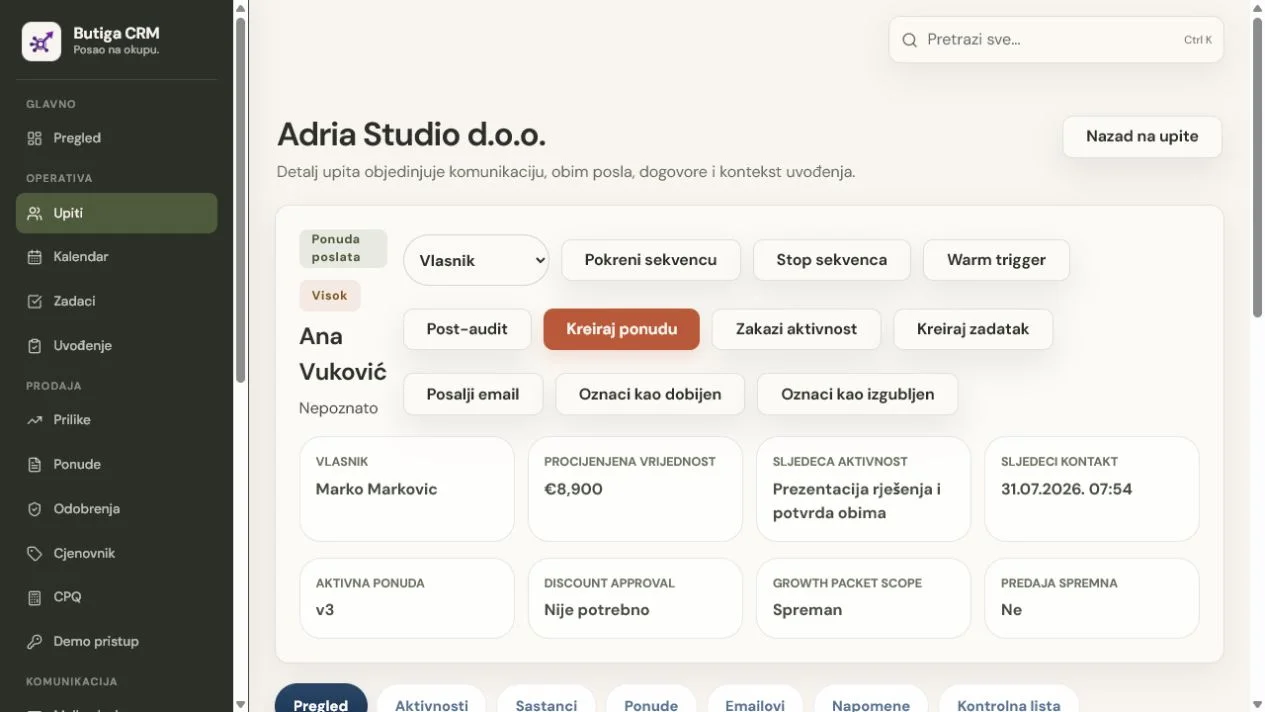
- An enquiry gets an owner. The company and contact enter a shared record with a source and first action.
- The conversation stays with the customer. An authorised colleague sees the business context instead of searching forwarded messages.
- The opportunity gets a stage and deadline. The team tracks value, expected decision date and next activity.
- The quote has a valid version. Items, price, discount, validity and decision remain connected.
- Won work is handed over. Operations receives scope, commitments and owners without another retelling.
Note: the workflow describes existing product functions. City and company examples are illustrative, not customer claims.
Three illustrative scenarios in Montenegro
A service company in Podgorica
One person receives the enquiry, another runs the meeting and a third prepares the quote. CRM should let each see the confirmed need, active quote version, owner and deadline without calling a colleague.
A supplier in Budva or Tivat
The decision depends on a seasonal deadline. Sales tracks the decision date, agreed quantities or scope and decision-maker. Won work moves to handover, while CRM does not replace hotel PMS, purchasing or inventory.
A field sales team across Montenegro
After a meeting, the salesperson finds the customer on a phone and records the next call or task. The manager sees the same item in the shared pipeline. Mobile functions should be checked against the plan and current app version.
CRM selection checklist
- Take three real opportunities: a new enquiry, a sent quote and work awaiting handover.
- Test the complete flow: customer, communication, stage, quote, task and outcome—not only the dashboard.
- Check access rights: who can see communication, prices, discounts, reports and administration?
- Ask about export and exit: how can data be exported and what happens after cancellation?
- Compare total cost: include users, email accounts, onboarding, migration and extra needs.
- Test with the team: Butiga offers a 14-day trial without a card; judge value using a real process.
Questions about CRM in Montenegro
Is Butiga made in Montenegro?
Yes. Butiga is developed and supplied by Temelj za rast, registered in Budva. Public legal and contact details are available on the website.
Does CRM replace accounting software?
No. Butiga manages sales customers, communication, opportunities, quotes, tasks and handover. Accounting, fiscalisation, inventory or payroll requires an appropriate ERP or specialist system.
Must a small company migrate all historical data immediately?
No. A practical start is to agree stages, ownership and required data, then move active customers and open opportunities. Scope depends on data quality and the agreed onboarding approach.
Can Butiga be tested without a card?
Yes. Current public terms state a 14-day trial without a payment card or automatic charge. Check the pricing page before deciding.
Test CRM with your process
Bring one anonymised enquiry, quote or late follow-up. In a Butiga CRM demonstration, check where the customer, email, owner, deadline and next step live. You can also review features or small-business CRM.