

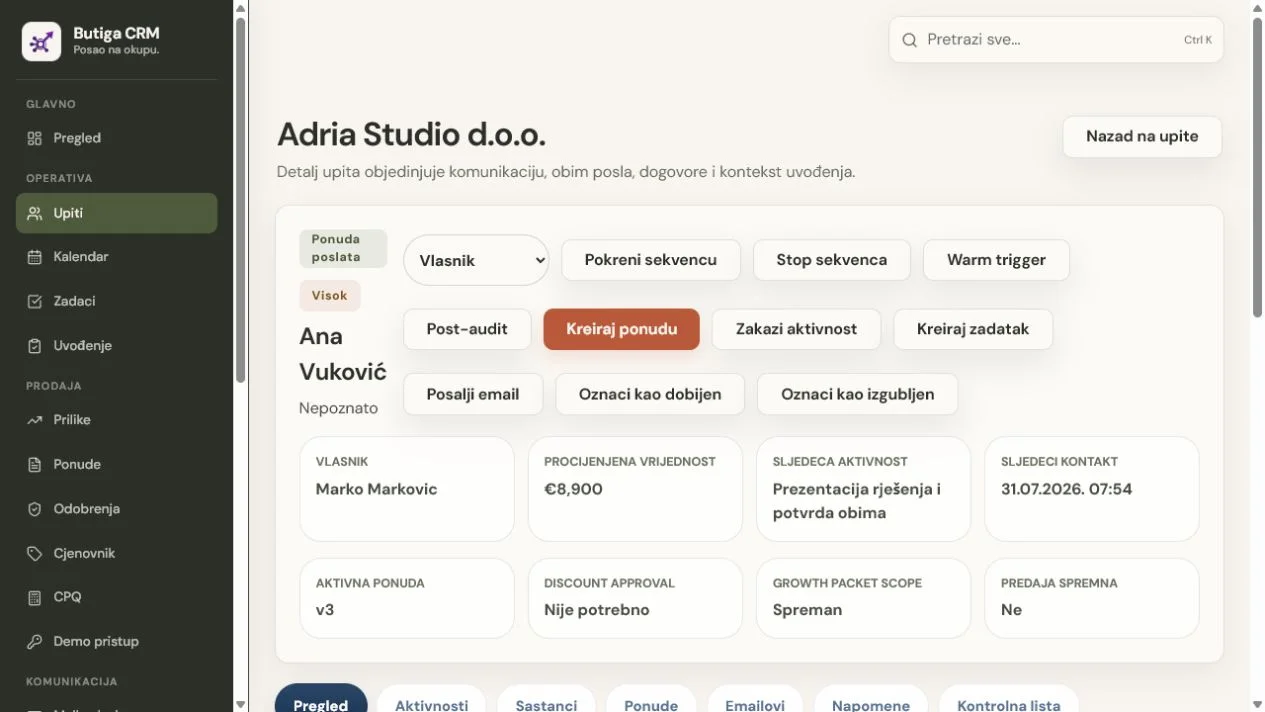
Sales handoff to operations in Butiga turns a won deal into a structured start to the relationship. The customer record retains the accepted quote, promises, exclusions, agreed price, customer dependencies, risks, onboarding owner and open tasks. Operations does not have to reconstruct the agreement from emails and private notes.
A won deal is not the same as a completed handoff.
“Won” means the customer has made a decision. It does not automatically mean operations has everything it needs. Without the scope, valid quote, onboarding owner or next steps, a deal is closed in sales but not ready operationally.
- Accepted quote.
Onboarding retains the quote version, agreed monthly price, one-off fee, currency and contract duration where entered. - Promises to the customer.
Sales records functionality, services, special work, deadline, including what is not part of the agreement. - Onboarding owner.
The new client gets the responsible person, so it's clear who's taking the context and taking the initial steps. - Dependencies and risks.
Required data, materials, access and internal warnings stay with the record instead of in a separate conversation. - Operational tasks.
Butiga can create tasks to review the promised scope, hold a kickoff and collect the access needed to start work. - Onboarding status.
The team distinguishes onboarding that has not started, is in progress, is waiting for the customer, is blocked, completed or cancelled.
What “ready for handoff” means
Butiga does not reduce readiness to a manually coloured label. It checks whether promises are recorded, an accepted quote is linked and an onboarding owner is assigned. When a Growth Packet is included, a complete scope with deliverables, channels, deadlines, inclusions and exclusions is also required.
The readiness signal does not guarantee successful onboarding. It confirms that the basic handoff elements are available in one place before operations starts work.
Illustrative example: from an accepted quote to kickoff
- The client accepts the offer. Sales records valid version, price, fees, duration and other commercial conditions.
- Sales confirms the promised scope. It lists deliverables, deadlines, customer dependencies, risks and exclusions.
- An onboarding owner is assigned. The responsible person gets a record of the client and can check the context before the first meeting.
- Butiga checks handoff readiness. A missing quote, owner, promise or required Growth Packet scope remains visible as an incomplete handoff.
- Initial tasks are created. The team reviews the deal, schedules the kickoff and requests the necessary information, materials or access.
- Onboarding receives a status. Operations moves the work through not started, in progress, waiting for the customer, blocked or completed.
Note: The example describes an actual product workflow, while the customer names and data on the screen are for demonstration.
What operations receives without another meeting to reconstruct the agreement
- the identity of the client and persons involved in the co-operation;
- the accepted version of the offer and agreed commercial data;
- a summary of the promised scope and special terms;
- clear exclusions;
- the data, materials and access the customer must provide;
- internal risks and comments relevant to the start of work;
- the onboarding owner, kickoff date, open tasks and current status.
The promise is locked, but changes are not forbidden
After handoff, the “Promised to the customer” entry has special significance. A later change may be justified, but should not erase history without an explanation. Butiga therefore requires a reason for changes after handoff. Sales and operations can distinguish the original agreement from a later agreed change.
A blocker needs an owner and a reason
“Blocked” is not a substitute for “waiting for something”. The onboarding record can contain the reason for the blockage, customer dependencies, required data and access, internal risks and next tasks. The manager can then see how many customers are waiting, how many are blocked and where an onboarding owner is missing.
Who onboarding and handoff in Butiga are for
- B2B sales teams
who, after accepting an offer, hand over the job to another person or department. - Service businesses
where delivery quality depends on the exact scope, deadlines and materials supplied by the customer. - Agencies and consultants
which must clearly separate the promised, additional work and items outside the agreed scope. - Teams with several parallel onboarding processes
needing an overview of owners, statuses, open tasks and blockers.
When you do not yet need a separate handoff process
If the same person sells, onboards and delivers a simple service without special access or materials, a short checklist may be enough. Structured handoff is most useful when several people participate and a poorly transferred agreement directly affects deadlines, costs or the customer relationship.
How to set up handoff without extra bureaucracy
Start with five questions: what the customer bought, what we promised, what is excluded, what we need from the customer and who owns the next step. Only then add the special fields your process needs. During a demo, we can walk through a typical sale and show where context currently disappears between quote acceptance and the start of work.
See how the deal is kept through quotes and price list, how business progresses through the sales pipeline or explore all Butiga features. For a handoff example that fits your team, book a demo.