

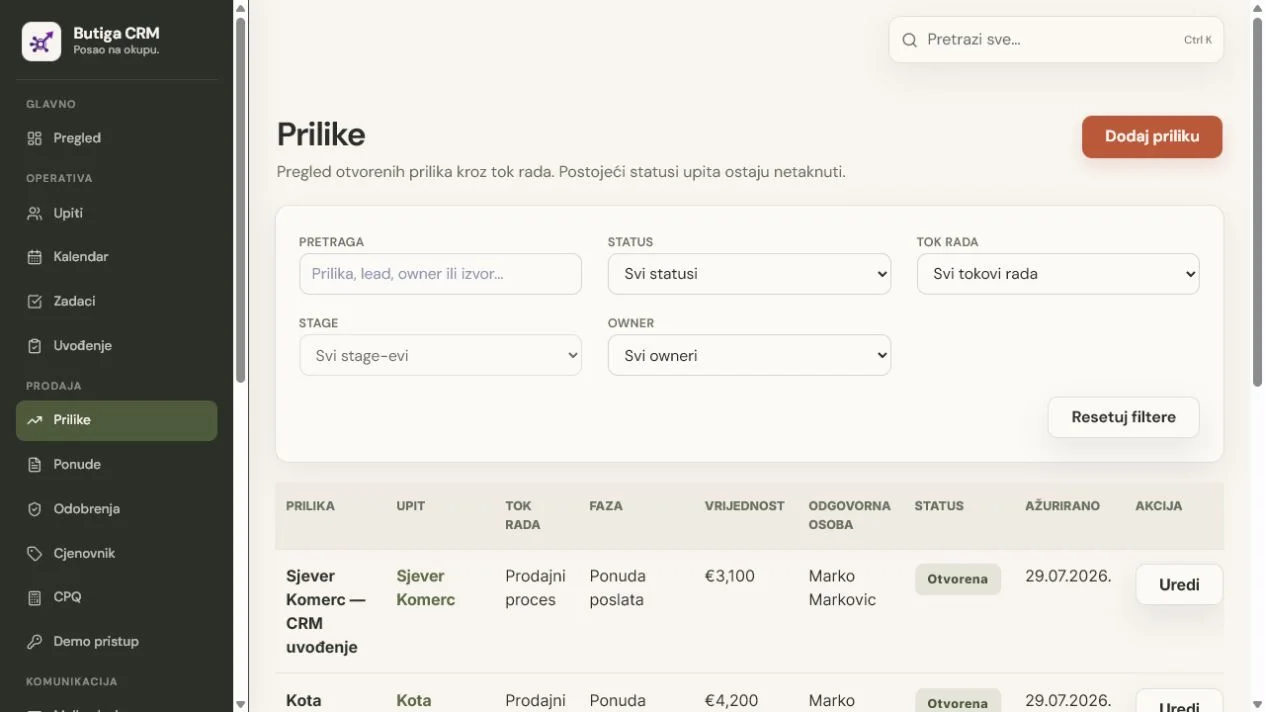
Organise sales by giving every active deal an owner, a clear stage, evidence that the stage's conditions are met and an agreed next step with a date. Stages should describe what actually happened between the company and customer, not the salesperson's mood. “Warm lead” is vague; “need confirmed and conversation scheduled” can be verified. The process ends when won work reaches the delivery team or a lost opportunity is closed with an actual reason.
Start before drawing the pipeline
The most common mistake is for the team to first draw columns in the CRM, and only then try to explain what they mean. Before the tool, map the actual path of one job.
- Where do enquiries come from? Web form, recommendation, email, phone, field or existing client may require a different initial response.
- Who's the first to respond? Define a person or assignment rule, rather than a shared inbox for which “everyone” is responsible.
- What must be known before the offer? The need, scope, deadline, budget framework, decision-maker or other information depends on your work.
- Who can confirm the price and the conditions? Discounts, special deadlines and deviations from standard scope need a decision owner.
- What happens after acceptance? Sales must know which information, documents and promises it hands to operations.
Process is not the same as status list
A status says where the deal stands. A process also defines how it got there, who is responsible, what must be done and which event moves it forward. Without entry and exit conditions, the team interprets stages by feel.
Five rules for a sales process the team can follow
- One Active Owner
Every lead and opportunity has someone responsible for accurate status and the next action. - The phase has proof
The business shall not move until the event has been defined or the necessary information has been confirmed. - Next Step Has Date
“Waiting for a reply” is not a plan. You need an action, owner and review date. - The offer has a valid version
The team must know what price, volume and conditions are sent or accepted. - The result closes the loop
Won deals enter handoff; lost deals get a reason that can be analysed later. - Required fields are rare and important
Require only information without which the next decision or handoff would be unreliable.
Example of the phases for the B2B sales process
This is not a universal Butiga template, it's an illustrative starting structure that needs to be adapted to the way your clients make their decisions.
| Phase | Input Condition | Required Action | Output |
|---|---|---|---|
| New enquiry | A useful contact or request has been received. | Assign the owner and determine the first answer. | Contact has been made or there is a valid reason for closing. |
| Qualification | There's a basic conversation with a potential client. | Check the need, fit, general parameters and next conversation. | There is a real opportunity or a clear reason not to continue. |
| Understanding the Need | The lead meets the basic criteria. | Set up scope, priorities, deadlines, participants and open questions. | The team has enough data to prepare an appropriate offer. |
| Quote preparation | It's confirmed what the client's looking for. | Select items, quantities, prices, discounts and necessary authorisations. | There's an approved version ready to go. |
| Offer sent | The client got the correct version of the offer. | Set a check date, answer questions and record changes. | Client accepts, rejects or enters into concrete alignment. |
| Decision | Open conditions and decision makers are known. | Resolve open questions without inventing certainty about the outcome. | The job was either won or lost for a recorded reason. |
| Won / Handoff | There's a confirmed commercial agreement. | Lock the valid scope and transfer promises, owners and tasks. | Operations confirms it can continue without reconstructing the agreement. |
| Lost | The client has refused, given up or the opportunity is no longer real. | Take note of the real reason and, when it makes sense, the date of future verification. | The opportunity no longer burdens the active pipeline. |
How to Name Stages
The name should describe the verifiable change. “Contact made” is clearer than “warm”. “The offer sent” is clearer than “90%”. The probability assessment may be a special information, but it should not replace the evidence that the actual event happened.
How many stages are enough?
Use the smallest number of stages that change the team's behavior. If the two adjacent stages do not have different input conditions, mandatory action or responsibility, they should probably be merged. If one phase hides several entirely different decisions, it may need to be separated.
Owner and next step keep the process alive
Pipeline without ownership is just a report. For every active job, it must be clear who is responsible for the data being accurate and that the next activity happens.
What the owner needs to maintain
- the current phase and the reason for the transition;
- the last important communication or note;
- the concrete next step and its date;
- the estimated value when there is a basis for it;
- open risks, issues and persons involved in the decision;
- the valid offer and the agreed status of the decision.
How to Write a Good Next Step
The next step should be an action, not a state. “Waiting for the customer” does not say what you will do. “Marko sends answers to technical questions by Thursday” or “Ana checks the decision on 4 August” can be carried out and verified.
Rules for a pipeline meeting
Do not read every opportunity in order. Review exceptions: deals without owners or next activities, overdue deadlines, too long in one stage, unapproved discounts or estimates without clear reasons. The meeting then serves decisions instead of manual status collection.
A quote is a checkpoint, not just a PDF
In many companies, sales becomes unclear when pricing preparation begins. The customer requests a change, a colleague sends another version, the manager approves a discount in a message and operations later receives a different document.
Define:
- who can select and change price list items;
- who can give a discount and to what level;
- where a special authorisation is required;
- how the current version is identified;
- which data must be confirmed before dispatch;
- what is locked after acceptance;
- how accepted scope moves into delivery.
Butiga supports items, quantities, discounts, approval workflows, versions, quote PDFs and locking the accepted version. Configure specific rules according to your company's responsibilities and approved price list.
The sales process ends with an organised handoff
“Won” is not the end if the delivery team still does not know what was promised. Handoff is a controlled transfer of commercial and operational context.
Minimum handoff checklist
- Valid scope
Which product, service, quantity or package is accepted. - Commercial conditions
The accepted price, discount and relevant conditions of the valid offer. - Promises
Deadlines, special requirements and restrictions confirmed during the sale. - Contacts
Who decides, who participates and who receives the next information from operations. - Open Questions
What hasn't been confirmed yet and who needs to make the decision. - Owner and first task
Who takes over the job and what activity begins the realization.
Illustrative example: a service company from enquiry to onboarding
- Adria Servis is sending in an inquiry. It asks about a new business service and states that it wants to decide within the month.
- Ana takes the lead. The first answer has a deadline, and the record gets the source and the basic contact.
- Qualifying conversation confirms the need. The goal, approximate scope and decision participants are known.
- The opportunity enters the stage of understanding the need. Ana schedules a meeting and records questions that must be answered for a reliable quote.
- The offer is prepared and approved. Items, quantities and special discounts pass through the responsible person before sending.
- The client is looking for a change. The new version replaces the previous one, but history remains with the same opportunity.
- The accepted version is locked. The sales opportunity moves to won only after the agreement is confirmed.
- Operations receives the onboarding record. Scope, promises, contacts, owner and first tasks are transferred without guesswork.
Note: Company names, people and data are for demonstration. The stages are a process example, not a mandatory configuration for every Butiga user.
What is worth measuring?
Measurement should guide decisions. A large dashboard has little value if the team does not know what to change based on its numbers.
| Indicator | Question answered | Possible decision |
|---|---|---|
| First Response Time | How long does a new enquiry wait for an owner and response? | Change the distribution or the order of duty. |
| Opportunities without a next activity | How much active work has no real plan? | Request a new action or close an unrealistic deal. |
| Time in phase | Where do the opportunities stand longer than the process expects? | Check the condition, responsibility or obstacle. |
| The conversion between phases | At which step do the most qualified opportunities drop out? | Improve the qualification, offer or way of making a decision. |
| Causes of loss | Are you losing because of price, fit, deadlines, competitors or silence? | Change the offer, targeting or follow-up. |
| Handoff with open questions | How many deals reach operations without full context? | Strengthen the closing condition and handoff checklist. |
Do not interpret win rate without context. If the team starts closing unqualified leads earlier, the percentage may change even while the process improves. Consider input quality, value, duration and actual reasons together.
Most frequent errors in the organisation of sales
- Too many stages. The sellers choose an approximate status because the difference between the adjacent columns is unclear.
- Stages based on feeling. “Warm”, “serious” and “90%” do not have evidence that another colleague can verify.
- Every lead enters the forecast. An unqualified enquiry looks like real revenue.
- There is no mandatory next step. The pipeline grows, but deals do not move.
- Shared ownership. When everyone is responsible, a commitment often has no specific owner.
- The offer is out of the process. The status, version and approval depend on private messages and file names.
- “Won” is treated as the final stage. Operations receives work without scope, promises or first tasks.
- CRM is only used for report to the manager. The team gains no daily benefit and updates information late.
- Everything is mandatory. Too many fields slow down the work and stimulate random input.
- The old table remains a parallel source. Nobody's sure what status is up to date anymore.
A four-step process introduction plan
1. Map the current flow
Choose several recent deals: won, lost and one still stalled. Record actual steps, handoffs, waiting periods and missing information.
2. Set minimum rules
Define stages, input and output conditions, owner, next activity, method of approval of the offer and handoff checklist. Do not attempt to cover any exception immediately.
3. Test on a small active sample
Several owners go through the same process in real work. Note where the rule is unclear, where there is a missing field and where the tool requires information that does not affect any decision.
4. Introduce an exception review
After the agreed date, CRM becomes the home for current stages and next actions. Weekly reviews cover deals without owners or next steps, overdue deadlines and deals too long in one stage. Rules change in a controlled way, with an explanation to the team.
Who needs more than this guide
If you have regulated sales, complex multi-stage authorisations, multiple legal entities, specific data retention or integration policies that affect price and execution, this framework is just the beginning. The process should be mapped in detail with responsible business, legal, security and technical persons.
How Butiga supports an organized process
Butiga connects leads and contacts, owners, statuses, pipelines, business email, activities, tasks, meetings, reminders, quotes, approvals and onboarding. History retains sales stage changes, and an accepted quote can carry the agreed context into work handoff. Access is checked by workspace, membership, roles and record permissions.
See the sales pipeline, quotes and price list and onboarding and handoffIf the sale is still in the table, read CRM vs Excel.
Translate one of your processes into clear rules
For a demo, prepare the anonymised structure of a typical deal: where the enquiry arrives, which decisions precede the quote, who approves prices and what operations needs. Do not send real personal or confidential data before agreeing on a secure review method. Based on the process, we can show where Butiga helps and what needs clarification first. Book a demo.
Apply process to CRM tools
For a review of the phases and specific activities see CRM sales pipelineBefore switching, use free CRM tools, calculator and checklist to assess the current situation and prepare the team.