
CRM and ERP solve different problems. CRM focuses on customers, leads, communication, sales opportunities, quotes and follow-up. ERP focuses on resources and business execution, including finance, accounting, purchasing, inventory, manufacturing or payroll. A company may need one system or both. The right choice starts by identifying where the largest operational loss occurs today.
What is the difference between CRM and ERP?
| Question | CRM | ERP |
|---|---|---|
| Main focus | Customer relationships and sales revenue | Resources, costs and execution |
| Typical data | Leads, contacts, email, opportunities, quotes and tasks | Ledger, invoices, inventory, purchasing, manufacturing and payroll |
| Primary users | Sales, account management and sales leaders | Finance, accounting, purchasing, warehouse and operations |
| Core question | What is the buyer waiting for and what happens next? | Which resource is required and how is the transaction executed? |
The category name is not enough. Some ERP products include CRM, while some CRM systems offer invoices, projects or operational add-ons. Ask to see the exact action and establish which system owns each record instead of relying on a module list.
When CRM is probably the first step
- enquiries remain in private inboxes;
- ownership and follow-up dates are unclear;
- opportunities lack consistent stages, value or a decision date;
- quote versions circulate without a clear status;
- a manager manually merges spreadsheets;
- operations does not receive confirmed scope and commitments.
Review the sales pipeline, business email and quotes and price list.
When ERP is probably the first step
- bookkeeping, tax or financial reporting is the main problem;
- you must control purchasing, inventory, batches, manufacturing or dispatch;
- fiscalisation and invoicing are central;
- you need payroll, fixed assets or detailed cost tracking;
- operational data must be unified across departments.
Butiga is not an ERP and should not replace these functions. In Montenegro, confirm financial and fiscal capabilities with an accountant or another qualified professional.
When a company needs both systems
Sales and execution often meet at the accepted quote. CRM keeps the conversation, need, commercial scope and decision. ERP can receive information required for an order, invoice, inventory movement or delivery. Integration does not have to be introduced on day one.
- The lead and contact enter CRM.
- Sales tracks the conversation, opportunity, quote and approval.
- The buyer accepts one identified version.
- An owner checks what must move to operations or ERP.
- ERP processes the invoice, inventory, purchasing or another execution step.
- Delivery status returns to sales only as needed for the customer relationship.
Note: this is an illustrative model, not a claim that Butiga has a ready-made integration with a named ERP.
Practical selection scenarios
A small consulting company
An external service handles accounting, while enquiries, meetings, quotes and follow-up are the largest problem. CRM is the logical first step. ERP can be assessed later if operational needs become more complex.
A wholesaler with inventory and field sales
Sales needs contacts, activities and pipeline, while operations needs stock, purchasing, dispatch and invoices. This often calls for both systems or one broader product that genuinely covers both teams.
A service company with tailored quotes
If an accepted quote defines scope and deadline, CRM helps the agreement reach delivery. If delivery involves detailed resource and cost planning, an operational or ERP layer is also required.
How to decide without buying the wrong system
- List the five costliest breaks. Where is information lost, a decision delayed or data entered twice?
- Classify them. Does each belong to sales and customers or finance, goods and execution?
- Choose the system of record. Where does each item originate, who changes it and which system is authoritative?
- Demonstrate a real process. The supplier should show your scenario, not only attractive screens.
- Check export, access and total cost. Include licences, onboarding, migration, support and integrations.
- Introduce the smallest useful scope. Confirm that the break is removed before adding modules.
Frequently asked questions
Does ERP always include CRM?
No. Some ERP products offer CRM, but feature depth and workflow vary. Test the route from enquiry to quote and follow-up.
Can a small company start with CRM only?
Yes, if accounting, fiscalisation and mandatory records already have an appropriate solution and sales is the main problem.
Must both systems be integrated immediately?
Not necessarily. First agree on the small set of data that must move between sales and execution. Growth and repeated entry can later justify integration.
Where does Butiga fit?
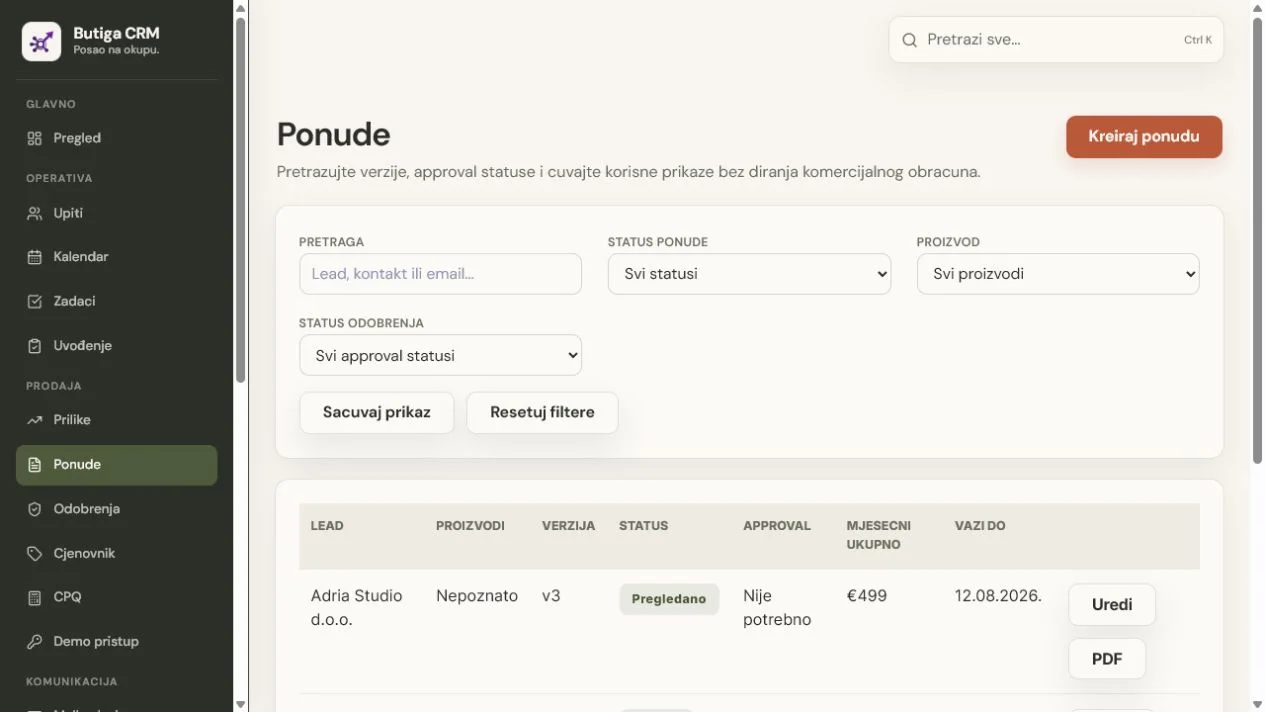
Butiga is CRM for sales, business email and quotes. It focuses on customers, communication, pipeline, tasks, price lists, quote versions and handover. It is not accounting, fiscal or inventory ERP.
Assess the sales part separately
If sales is the priority, test the route from enquiry to accepted quote. Review CRM for Montenegro, compare pricing and data access, then book a demo if the product fits the problem.